Watkins Glen State Park is in the village of Watkins Glen, south of Seneca Lake in Schuyler County in New York’s Finger Lakes region. The centerpiece of the 778-acre park is a 400-foot-deep narrow gorge cut through rock by Glen Creek.
We visited Watkins Glen State Park in mid-July 2025 while staying at the Watkins Glen / Corning KOA Resort a few miles away. We parked at the Upper Entrance parking area which is actually at the west end of the gorge. The gorge runs between this parking area and the Main Entrance parking area at the east end of the park in the Village of Watkins Glen.
From the Upper Entrance parking area, we descended through the gorge on the Gorge Trail which is the closest trail to the stream and runs over, under and along the park’s 19 waterfalls by way of stone bridges and more than 800 stone steps. Along the trail we passed several landmarks including Jacobs Ladder (a set of stone steps that form the initial descent into the gorge), Mile Point Bridge, Frowning Cliff, Rainbow Falls, Central Cascade, and Glen Cathedral. The scenery along the Watkins Glen gorge was stunning, with spectacular views around every bend.
We dropped about 500-ft in elevation from the start of the approx. 1.2-mile Gorge Trail to Point Lookout where we ascended a set of stone steps to the North Rim Trail that took us back to the Upper Entrance Parking area along the top of the gorge. The North Rim Trail is a natural trail which gradually climbs through the forested rim of the gorge. This contrasted with the stone walkways, steps, and bridges that made up the much more spectacular, but also more crowded Gorge Trail below.
The trails can be hiked out-and-back as we did, but if you only want to hike one-way there is a park shuttle that runs from one end of the park to the other throughout the day. Photos of our visit are provided below. Click on the thumbnails to view the full-size pictures.
We made two half-day trips to the Petrified Forest National Park in early November 2023 while staying at the Holbrook/Petrified Forest KOA Journey RV Park, about a half-hour drive from both the south and north park entrances. The Petrified Forest National Park stretches north and south between Interstate 40 and Highway 180. There are two entrances into the park, each one with a visitor center. The petrified log fields are found at the southern end of the park. Outlooks, trails, cultural sites, and painted desert badlands are found in the middle and northern sections.
During both of our visits we drove the full length of the park, southbound on the first trip, and northbound the second time. We stopped at some different overlooks and points of interest each day.
The Painted Desert has a very unique, other-worldly, landscape with colored bands running horizontally through its rolling hills. The colorful Painted Desert badlands are composed of bentonite, a product of altered volcanic ash. The clay minerals in the bentonite can absorb water and swell much as eight times their dry volume. The expansion and contraction properties of the bentonite cause rapid erosion including by preventing much vegetation from growing on—and thus fixing—the slopes of the hills.
There were also views of spectacular mesas and buttes along the park road. Their flat tops are created by the presence of cap rocks, more erosion-resistant rock such as sandstone over softer clays. The softer rock is protected by the cap stones, but, as the sides weather and the protective rock falls down, the softer rock erodes away as it is exposed to the elements. Without the capstone, the feature becomes another rolling badland. Mesas typically are wider than they are tall while buttes are taller than they are wide. Towers, monuments, and hoodoos are even further eroded features.
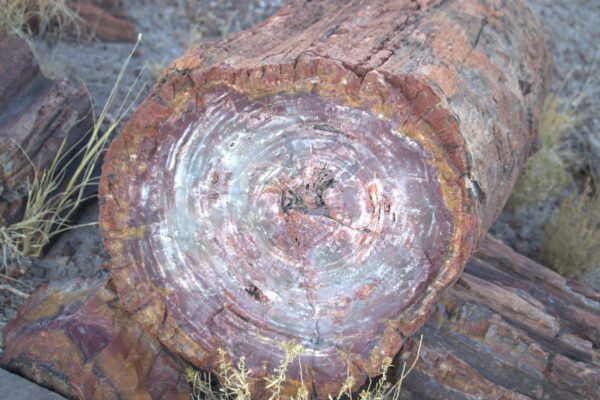
The petrified trees that lie strewn throughout the southern sections of the park are an amazing sight. Initially, looking out over the fields of petrified logs, you might think you are looking at the remnants of recently felled trees, but then you realize that these are actually fossilized trees that are some 200 million years old, and there is a sense that time has stood still in these areas. The quartz within the petrified wood is hard and brittle, fracturing easily when subjected to stress. It is thought that during the gradual uplifting of the Colorado Plateau, starting 60 million years ago, the still buried petrified trees were under so much stress they broke like glass rods. The crystal nature of the quartz created clean fractures, evenly spaced along the tree trunk, giving the appearance today of logs cut with a chainsaw.
Towards the north end of the park, we visited the cultural site of the Puerco Pueblo. A 0.3-mile paved walk winds through the remains of a hundred room pueblo, occupied by the ancestral Puebloan people over 600 years ago. We were able to see Petroglyphs along the south end of the trail, that are still clear and well defined hundreds of years after they were created.
Probably our favorite spot in the park was the Blue Mesa trail, a 1-mile loop descending from the mesa through the hills of the Painted Desert badlands. The loop trail offers the unique experience of hiking among badland hills of bluish bentonite clay as well as petrified wood. We wandered among the hills and petrified logs and were again struck by the timeless quality of the area.
We were able to take the dogs with us on the Giant Logs trail, a 0.4-mile loop behind Rainbow Forest Museum towards the south end of the park. The trail winds around some of the largest and most colorful logs in the park. “Old Faithful”, at the top of the trail, is almost ten feet wide at the base!
Photos of our visit are provided below. Click on the thumbnails to view the photos.
PLEASE NOTE: This post got the better of me, and I went down a rabbit hole. I still have a minor cleanup, but I wanted to post it as soon as possible. Sorry for the rough draft version, but it’s better than nothing. I hope you find her as interesting as I did. This cabin is one of my favorite places to visit. I find it absolutely beautiful.
Josie Bassett Morris’ Cabin at Cub Creek (40°25′31″N 109°10′29″W) near Jensen, Utah. Source: Allen
Photos By: 365RVLiving.com and courtesy of the J. Willard Marriott Digital Library at the University of Utah (https://collections.lib.utah.edu/)
Josie Morris’ cabin is one of my favorite places I’ve ever visited—so much so that we’ve made the trip out to it from Vernal, Utah, for the second consecutive year. While researching the cabin for this post, I found Josie’s and her family’s story captivating. Their story is truly a fantastic part of the American West. I can easily imagine living there in the late 1800s or early 1900s. I love this small cabin’s mature trees, solitude, and isolation.
Petroglyphs and pictographs on rocks along the road to Josie’s cabin. Source: Allen
It’s several miles down a small county road just off Old Hwy 149 inside Dinosaur National Monument. The last few miles of the road are a well-maintained dirt road, but any car can drive unless it has recently rained. On the way to the cabin, ancient petroglyphs and pictographs were created on nearby walls by the Freemont people living there from around 200 AD to 1300 AD.
There is a small parking lot at the cabin, and two easy hiking trails start there: the Hog Canyon trail and the Box Canyon trail. The Hog Canyon trail is the longer (1.5 miles) and more diverse of the two, while the Box Canyon trail is significantly shorter (0.5 miles) but still beautiful. Please be aware that there is a lot of Poison Ivy along the Hog Canyon trail.
Originally from Arkansas, Herbert and Elizabeth Bassett moved west circa 1877 with their three-year-old daughter, Josie. She and her younger siblings, Samuel Clark Bassett Sr, Ann M (Bassett) Willis, Elbert Bassett, and George Crawford Bassett, grew up in Brown’s Park (originally Brown’s Hole), an isolated mountain valley on the Green River near the Colorado/Wyoming/Utah border known for cattle rustlers, horse thieves, and outlaws.
Due to poor health, Herb, a scholar and musician, could not perform hard labor. Elizabeth, a strong, outdoorsy woman, realized that she needed to provide a living for the family and became a cattle rancher and rustler. She ran the cattle and sheep ranch and raised thoroughbred horses while Herb taught the children.
Josie’s mother, Mary Elizabeth (née Chamberlain) Miller, Attributed to Surreywd2541, CC BY-SA 4.0, via Wikimedia Commons
Elizabeth and Herbert Bassett were comparatively wealthy and educated for homesteaders. By all accounts, they had an unusually open-minded marriage for the time. Elizabeth advocated for women’s right to vote, was interested in feminism, and believed one’s roles should be based on talent and interest rather than gender.
When large cattle companies began to push out small cattle ranchers and homesteaders in Brown’s Park, the Bassetts organized other locals to fight back. They hosted many guests in their home, fostering a strong sense of hospitality, generosity, and community. Some of their guests included Butch Cassidy, Harry Longabaugh (aka. The Sundance Kid), and the “Wild Bunch” gang. They all were close family friends and often stayed and worked at the ranch to “cool down” following their illegal escapades. The Bassetts were known for supplying Butch Cassidy’s gang and other outlaws, such as “Black Jack” Ketchum and Kid Curry, with beef and fresh horses.
Butch Cassidy (seated far right), “Sundance Kid” (seated far left), and three other members of the Wild Bunch in the famous “Fort Worth Five” photograph taken in 1900. Mouse over a person for the name or click them for more information. Source: Wikipedia
Josie and Ann were both considered very attractive and had a wild side. By 1893, Ann was involved romantically with Butch Cassidy, and Josie was involved with Elzy Lay, Cassidy’s closest friend.
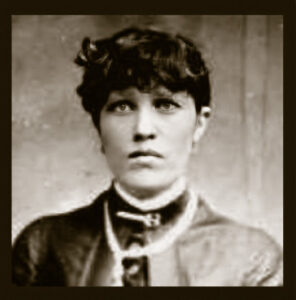
While Cassidy was in prison, Ann became involved with Ben Kilpatrick, another outlaw. By the time Cassidy was released, Will “News” Carver, a “Wild Bunch” member, had become involved with Josie. She ended their relationship when Carver became involved with another “Wild Bunch” member and outlaw, Laura Bullion. Subsequently, Josie becomes involved with Cassidy until he again becomes involved with Ann.
The Bassett girls’ relationships with Cassidy’s Wild Bunch gang developed into a complicated circle. Despite the seemingly constant changes in romantic companions between them and the gang members, there is no indication that animosity ever resulted from this.
In 1896, several powerful and wealthy cattlemen hired cowboys to harass the sisters, stampede, and rustle their cattle to force the sisters to sell their ranch. As a result, the sisters began rustling the cattlemen’s cattle. Fortunately, the cowboys only had limited success as they feared retribution from the Bassett’s outlaw friends.
One legend is that Kid Curry, the most feared of the Wild Bunch, approached several cowboys who worked for the cattlemen and warned them to leave the Bassetts alone. It’s unknown if this story is true, but it is true that by 1899, the sisters were no longer receiving pressure to sell.
Josie married Jim McKnight at the age of 19 in 1893. In 1914, Josie and husband M.B. (Ben) Morris, without much money, established a homestead claim at Cub Creek near Split Mountain (the cabin location within the current Dinosaur National Monument), 40 miles from the family ranch. Her son Crawford and his wife lived there for a time, and grandchildren visited.
Morris was a colorful local character. She married five times and divorced four of her husbands. In her 60s, she was tried and acquitted for cattle rustling and made brandy and wine from local fruit and berries during Prohibition. She lived in the cabin for over fifty years until she fell on ice and broke her hip in 1963. She died the following year at the age of 90.

 Watkins Glen State Park is in the village of Watkins Glen, south of Seneca Lake in Schuyler County in New York’s Finger Lakes region. The centerpiece of the 778-acre park is a 400-foot-deep narrow gorge cut through rock by Glen Creek.
 The scenery along the Watkins Glen gorge was stunning, with spectacular views around every bend.