Winter 2024/25 Review and 2025/26 Preview
(Where we’ve been and where we’re going!)

Winter 2024/25 Review and 2025/26 Preview(Where we’ve been and where we’re going!)

Where we’ve been and where we’re going!

For the third year in a row, we spent winter 2024/2025 at Mayflower County Park near Blythe, California amongst old and new RVing friends. We arrived in early December 2024 after spending summer and fall on the west coast gradually making our way south through Washington, Oregon, and California with some great stops along the way. Pictures from our winter stay at Mayflower are provided at the end of this post. Our days at Mayflower were filled with walks around the nearby Palo Verde Ecological Preserve, walking the dogs in the park, monthly potlucks and ice cream socials, surprisingly competitive lawn bowling, discussions and reminiscences around the evening firepit, and trips to Blythe and Quartzite. This winter we also visited the Blythe Intaglios for the first time. These are a fascinating group of well-preserved geoglyphs that were created by humans for an as-yet-unknown reason, but clearly had a meaningful purpose for those that did create them.

We stayed at Mayflower County Park in our new 30-ft Grand Design Transcend 240ML travel trailer while our 5th wheel was being repaired. Our winter stay lasted for about 3-months before we headed to Casa Grande, Arizona for a couple of weeks in early March 2025. By then we received word that our 5th wheel repairs were complete in Arroyo Grande, California (San Luis Obispo County), so we schedule a few stops along the 400-mile trip to pick up the 5th wheel in late March 2025.

The 5th wheel repairs were done by Mullahey Collision & RV Service Center, and we were very happy with their work. They did a great job of the bodywork and interior repairs, including replacing the three-way refrigerator workings and completely rebuilding the kitchen slide and pantry. Fortunately, the repairs were fully covered by Progressive Insurance, and Mullahey did a great job of coordinating insurance company approvals for all of the work.

We had originally planned to switch back into the 5th wheel and store the new trailer for our upcoming trip, but after a few months of living in the new trailer we decided, instead, to take it on our trip and store the 5th wheel. We figured there would be some tight roads and campgrounds as we head to the east coast, and the smaller trailer will make travel easier and give us more flexibility on where we can stay.

Since putting the 5th wheel in storage in late March, we’re now officially on our “east coast trip”. The highlight of the year is going to be seeing fall colors in the US Northeast, and then traveling from north to south through most of the east coast states with a plan to spend winter 2025/2026 in Florida. As we get into 2026 we plan to spend spring and summer in the southern states visiting some of Allen’s family and then head up through the Midwest states through late summer, finally looping to the south through Colorado, and making our way back to Southern California by late 2026. That’s a big trip, and if we follow the current plan, we will have RVed through all 48 contiguous states by the time we complete it. The picture shows a map of our planned 2025/2026 trip.

At the time of this post (late April 2025), we’re in Tennessee. Since leaving California in late March, we’ve stayed in Arizona, New Mexico, Texas, Oklahoma, and Arkansas. A recent highlight of our travels was a visit to Carlsbad Caverns National Park in New Mexico, and we will post a separate description of that visit on our blog.

Monterey Bay Aquarium

Monterey Bay Aquarium

We visited Monterey Bay Aquarium on a sunny day in late October 2024. The aquarium is located right on the Pacific Ocean in Cannery Row, Monterey, California. The museum, and the Cannery Row area have repurposed old sardine cannery buildings to create an attractive tourist area with a variety of hotels, stores and restaurants.

We were fortunate to visit on a mid-week day so crowds were relatively light. We were told by staff that the aquarium was at about 20% of its capacity on the day we visited. It is easy to imagine how crowded the aquarium must be at full capacity. Although the aquarium doesn’t have its own parking, we were able to book parking on-line in advance at a nearby parking lot right across the street.

The aquarium had recently opened its newest exhibit called “Into the Deep” featuring the largest collection of deep-sea animals in North America.  We particularly enjoyed the spectacular sea jelly displays. We spent several hours at the aquarium and were able to visit all of the exhibits. We enjoyed the variety of ocean life on display that included fish, corals, crustaceans, wading birds, sea otters, and penguins. Having visited several large aquariums, the Monterey Bay Aquarium stands out to us as one of the best.

A gallery of some of our photos from the visit are below. Click on the thumbnails to view the photos.

Joshua Tree National Park

Joshua Tree National Park

While the Joshua Tree area has been inhabited by humans for at least 10,000 years, by the late 1920s the development of new roads into the desert had brought an influx of land developers and cactus poachers. Minerva Hoyt, a Pasadena resident who was extremely fond of desert plants, became concerned about the removal of cacti and other plants to the gardens of Los Angeles. Her tireless efforts to protect this area culminated in 825,000 acres being set aside as Joshua Tree National Monument in 1936. As part of the Desert Protection Bill, Joshua Tree National Monument was elevated to National Park status on October 31, 1994. The bill also added 234,000 acres. Elevations in the park range from a low of 536 feet to a high of 5,814 feet at Quail Mountain.

We visited Joshua Tree National Park in late November 2024 while staying at the Thousand Trails Palm Springs RV Park in Palm Desert, California. We entered the park at the Cottonwood entrance at its southeast side, stopping at the small visitor center on the way. Following Pinto Basin Road to Park Boulevard generally took us from the southeast side of the park to the northwest side, eventually exiting at the West Entrance Station.

While we had visited Joshua Tree a number of times over the years, this was our first time driving the full length of the park and we got to appreciate the wide variety of scenery and ecosystems that exist in addition to the famous Joshua Trees that everyone associates with the park. There are three unique ecosystems within the park. As we entered at the southeast side, we found ourselves in the Colorado Desert that was characterized by stands of spike-like ocotillo plants and “jumping” cholla cactus. We stopped at the Cholla Cactus Garden which includes a flat 0.25-mile loop trail. We walked through a section of the thousands of teddy bear cholla cactus with a backdrop of distant mountain views.

As we continued along the road, we passed from the Colorado Desert into the southern boundary of the Mojave Desert which reaches across the northern part of the park. This is the habitat that includes the park’s namesake: the Joshua tree. We stopped at several areas along the road where there were many photo-ops. Along the way we pulled into the Live Oak Picnic area, driving a short distance on dirt roads to a secluded spot among the Joshua Trees and rock formations to enjoy a late picnic lunch as the sun was low in the sky on this short winter day. As we drove out of the park at its northwestern side, we got glimpses of Joshua Tree’s third ecosystem where the Little San Bernardino Mountains provide habitat for a community of California juniper and pinyon pine above 4,000 feet.

Our half-day visit to Joshua Tree was an enjoyable trip through the variety of ecosystems, geological features, and plants to inhabit the park, and we learned there was more to the park than just the eponymous Joshua Tree plants.

Photos of our visit are provided below. Click on the thumbnails to view the photos.


Redwood National and State Parks

Redwood National and State Parks

In 1918 paleontologists wanting to save the Coast Redwoods as a living link to our evolutionary past campaigned nationally to protect the trees. Three California redwoods state parks resulted: Prairie Creek (1923), Del Norte (1925), and Jedediah Smith (1929). To preserve the trees’ natural Coast Range setting and associated plants and animals, Redwood National Park was created in 1968 and expanded in 1978. The national park boundary encircled the three state parks to better protect superlative ancient redwood forests. In 1994 the National Park Service and California Department of Parks and Recreation began managing the parklands cooperatively, aiming to manage the parks the same.

Redwood National and State Parks holds 130,000 acres of forests, rivers, prairies, and rugged coastline, including 40,000 acres of old-growth redwood forests. Today, the Parks’ boundary extends from Crescent City, CA to just south of Orick, CA.

We visited Redwood National and State Parks in October 2024 while staying at the Rambling Redwoods RV Park in Crescent City, California at its northernmost end. We made a couple of visits to the park during our stay. The first visit was to Jedediah Smith State Park near Crescent City. During the second visit we drove most of the length of the park from north to south on the CA-101 with a detour along the Newton B. Drury Scenic Parkway.

Our visit to Jedediah Smith State Park started at the Hiouchi Visitor Center, a short drive from the RV park and just outside Crescent City. At the visitor center we were given printed directions to get to Howland Hill Road, a 10-mile narrow scenic drive which winds through the giant Redwoods and includes numerous pull-outs to allow vehicles to pass, and trailheads along the way, including the Boy Scout Tree Trail , Stout Grove, and Grove of the Titans Trail. Portions of Howland Hill Road were unpaved, but the road was readily passable by any passenger vehicle, although it was so winding and narrow that we rarely exceeded 15 mph along the road. The drive was spectacular, with giant redwoods literally inches from the road on each side, and shafts of light shining dramatically through the tree canopy.

We decided to take the Grove of the Titans Trail about half-way along Howland Hill Road. This trail was completed in summer 2022 to allow sustainable access to a group of ancient redwood trees named for their remarkable shape and size. The grove contains many tall and wide redwoods with complex features and fascinating adaptations. The trail was a 1.5-mile out and back trail with a small loop at the end. There were many awe-inspiring giant trees along this trail and some of the fallen trees were just as spectacular and interesting as the living ones. After our visit to the Grove of Titans, we completed the Howland Hill Road drive back to Crescent City.

For our second trip into the park, we drove the CA-101 most of the length of the park from north to south with a detour along the Newton B. Drury Scenic Parkway. The Scenic Parkway is a 10-mile section of two lane highway that bypasses a section of CA-101 through the heart of the old-growth redwood forest in Prairie Creek Redwoods State Park. North to south, features include numerous trailheads, Big Tree Wayside, Prairie Creek Visitor Center, and Elk Prairie Campground.

As we continued along the Scenic Parkway, we stopped at the Big Tree Wayside area. This is an easy walk to stunning old-growth redwood trees. A viewing platform and interpretive signage was located around the “Big Tree”, said to be one of the oldest in the park with a height estimated to be 286-feet and a diameter of 25-feet. We took a short circle trail next to the big tree that took us through even more spectacular Giant Redwood specimens.

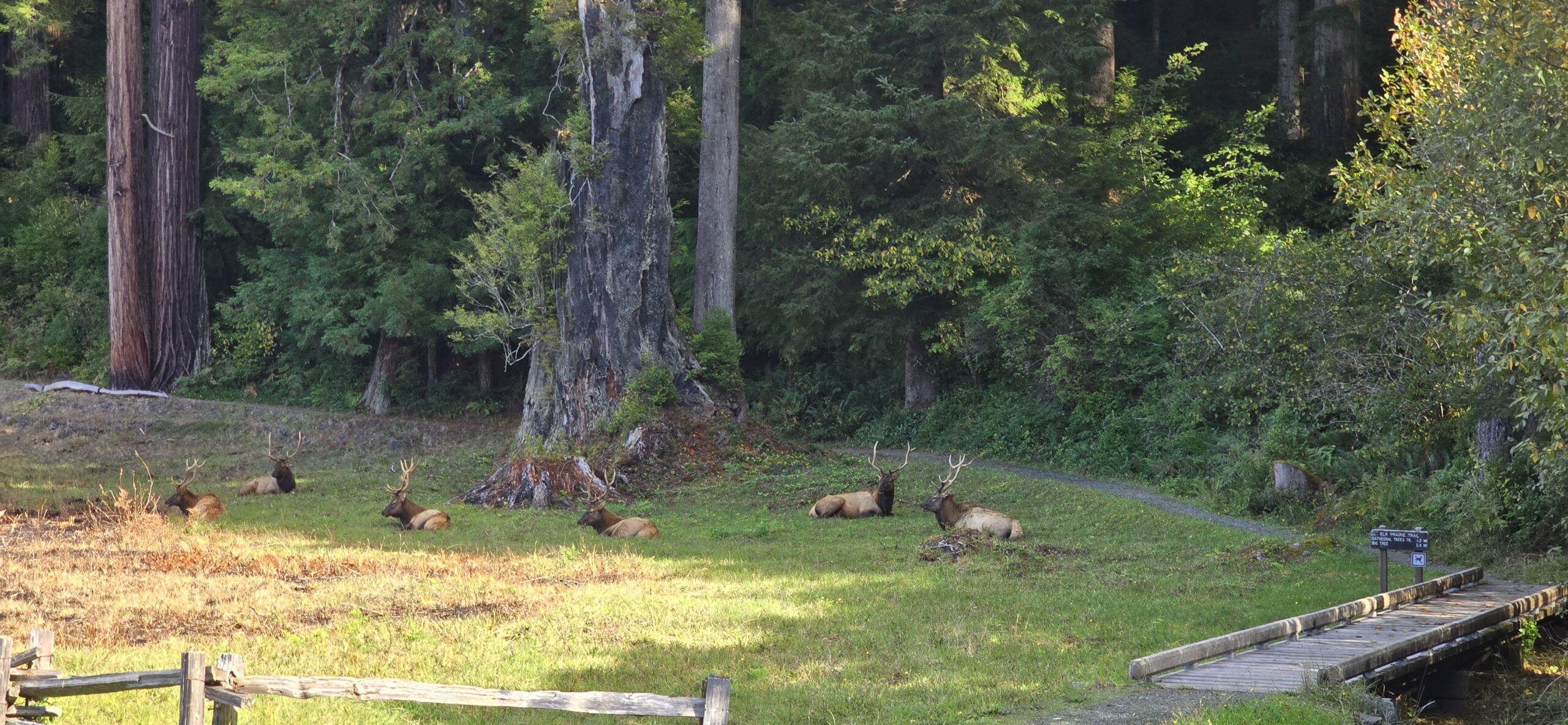
One of the highlights of this visit were the herds of Roosevelt Elk that live around the Elk Prairie area. We were able to watch the Elk as we picnicked at the Elk Meadow picnic area, and then again at the Elk Prairie area a short distance along the scenic parkway. These large Elk were quite majestic as they relaxed in the meadows.

We ended our trip at the Thomas H. Kuchel Visitor Center, located on the Pacific Coast. Exiting the back-door of the visitor center directly onto a sandy beach covered in driftwood, we were met with spectacular views up and down the coast, accompanied by the white breakers reflecting the low afternoon sun.

We really enjoyed our time in the Redwoods. There was a real sense of timelessness amongst trees that have been here for up to 2000 years, and gratitude for the work that has been put-in by the Park Services and others to protect the ancient forests and surrounding areas.

Photos of our visit are provided below. Click on the thumbnails to view the photos.

×