Winter 2024/25 Review and 2025/26 Preview
(Where we’ve been and where we’re going!)

Winter 2024/25 Review and 2025/26 Preview(Where we’ve been and where we’re going!)

Where we’ve been and where we’re going!

For the third year in a row, we spent winter 2024/2025 at Mayflower County Park near Blythe, California amongst old and new RVing friends. We arrived in early December 2024 after spending summer and fall on the west coast gradually making our way south through Washington, Oregon, and California with some great stops along the way. Pictures from our winter stay at Mayflower are provided at the end of this post. Our days at Mayflower were filled with walks around the nearby Palo Verde Ecological Preserve, walking the dogs in the park, monthly potlucks and ice cream socials, surprisingly competitive lawn bowling, discussions and reminiscences around the evening firepit, and trips to Blythe and Quartzite. This winter we also visited the Blythe Intaglios for the first time. These are a fascinating group of well-preserved geoglyphs that were created by humans for an as-yet-unknown reason, but clearly had a meaningful purpose for those that did create them.

We stayed at Mayflower County Park in our new 30-ft Grand Design Transcend 240ML travel trailer while our 5th wheel was being repaired. Our winter stay lasted for about 3-months before we headed to Casa Grande, Arizona for a couple of weeks in early March 2025. By then we received word that our 5th wheel repairs were complete in Arroyo Grande, California (San Luis Obispo County), so we schedule a few stops along the 400-mile trip to pick up the 5th wheel in late March 2025.

The 5th wheel repairs were done by Mullahey Collision & RV Service Center, and we were very happy with their work. They did a great job of the bodywork and interior repairs, including replacing the three-way refrigerator workings and completely rebuilding the kitchen slide and pantry. Fortunately, the repairs were fully covered by Progressive Insurance, and Mullahey did a great job of coordinating insurance company approvals for all of the work.

We had originally planned to switch back into the 5th wheel and store the new trailer for our upcoming trip, but after a few months of living in the new trailer we decided, instead, to take it on our trip and store the 5th wheel. We figured there would be some tight roads and campgrounds as we head to the east coast, and the smaller trailer will make travel easier and give us more flexibility on where we can stay.

Since putting the 5th wheel in storage in late March, we’re now officially on our “east coast trip”. The highlight of the year is going to be seeing fall colors in the US Northeast, and then traveling from north to south through most of the east coast states with a plan to spend winter 2025/2026 in Florida. As we get into 2026 we plan to spend spring and summer in the southern states visiting some of Allen’s family and then head up through the Midwest states through late summer, finally looping to the south through Colorado, and making our way back to Southern California by late 2026. That’s a big trip, and if we follow the current plan, we will have RVed through all 48 contiguous states by the time we complete it. The picture shows a map of our planned 2025/2026 trip.

At the time of this post (late April 2025), we’re in Tennessee. Since leaving California in late March, we’ve stayed in Arizona, New Mexico, Texas, Oklahoma, and Arkansas. A recent highlight of our travels was a visit to Carlsbad Caverns National Park in New Mexico, and we will post a separate description of that visit on our blog.

Coronado Village Mobile Home & RV Resort – Albuquerque, NM

Coronado Village Mobile Home & RV Resort – Albuquerque, NM

Coronado Village Mobile Home & RV Resort is one of our favorite RV parks. Nestled in north Albuquerque, NM, near I-25 and Paseo Del Norte Blvd NE, it’s a surprisingly tranquil spot despite its proximity to the freeway, thanks to its vastness with 350 spaces. We visited twice in May 2023 during spring and again in October 2023 for the Albuquerque Balloon Fiesta.
We travel to Albuquerque often due to Martin’s Vedic chanting workshops and prefer to stay at Coronado Village. No amenities are within walking distance unless you’re up for a mile or two trek.

The standout feature of this park is its 7-acre grassy area at the southern end. Google calls it Scallop Park, though it’s entirely within Coronado Village. The greenbelt boasts large cottonwood, fir, cedar, and mulberry trees.

Springtime in the park is delightful. There is a blanket of yellow dandelions and their seedheads, and the mulberry and cottonwood trees are budding with new growth as the temperature starts heating up. October weather can be cool, but it’s not too cold yet.

During our first visit in May 2023, I expressed interest to the office staff that we would like to attend the balloon fiesta in October 2024. Coincidentally, there was a cancellation on our departure day for the October 2023 Albuquerque Balloon Fiesta. We snagged the reservation immediately, even though the rates spiked during the event. Coronado Village is very close to the fiesta grounds.

October’s visit was spectacular, with balloons landing in the RV park, even right in front of our RV. The weather cooled quickly, requiring a heavy sweater by the end of the month. Early October was mild enough for just a light jacket, even for nighttime fiesta events, to which we rode our e-bikes.

A useful tip we’ve learned for saving money while traveling is to stay for a month when possible, as it often costs about the same as a two-week stay. This usually requires paying for electricity, but staying longer allows us to slow down and truly enjoy the area.

White Sands National Park

White Sands National Park

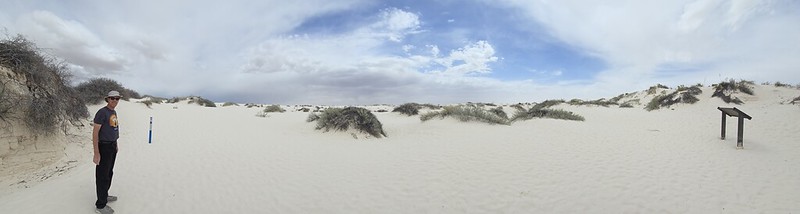
Rising from the heart of the Tularosa Basin is one of the world’s great natural wonders – the glistening white sands of New Mexico. Great wave-like dunes of gypsum sand have engulfed 275 square miles of desert, creating the world’s largest gypsum dune field. White Sands National Park preserves a major portion of this unique dune field, along with the plants and animals that live here.

We visited the White Sands National Park in early April 2024 while staying at the Hacienda RV Resort in Las Cruces, New Mexico about a one-hour drive away.

We stopped at the visitor center at the park entrance and learned about the unique gypsum dunes. Approximately 12,000 years ago, the land within the Tularosa Basin featured large lakes, streams, grasslands, and Ice Age mammals. As the climate warmed, rain and snowmelt dissolved gypsum from the surrounding mountains and carried it into the basin. Further warming and drying caused the lakes to evaporate and form selenite crystals. Strong winds then broke up crystals and transported them eastward. A similar process continues to produce gypsum sand today.

From the visitor center we took the Dunes Drive, an eight-mile out-and-back scenic drive that leads from the visitor center into the heart of the gypsum dune field. Along the road, there were outdoor exhibits, hiking trails, and picnic areas. Our first stop was the Dune Life Nature Trail. This was an easy one mile loop trail that was a great way to experience the dune field, and its typical landscape of sparse shrubs, cacti, and trees. There were informational signs along the loop.

We also visited the Interdune Boardwalk, an elevated boardwalk that leads you through the fragile interdune area to a scenic view of the dune field and the Sacramento mountains. There were extensive information displays along the boardwalk with information on the geology, plants, and animal life of the area.

We tried our hand at sand sledding, one of the most unique things to do in White Sands National Park. We met with little success and came to the conclusion that if you weigh more than the average 12-year-old, the physics of sand sledding are not in your favor!

Visiting Great Sand Dunes National Park was a unique experience. Some areas of the park had very little plant life and the bright white gypsum dunes looked just like snow drifts. Interestingly, the dunes always stay fairly cool even on bright sunny days due to the high water table and reflective sand.

Photos of our visit are provided below. Click on the thumbnails to view the photos.


Saguaro National Park – Tucson, AZ

Saguaro National Park – Tucson, AZ

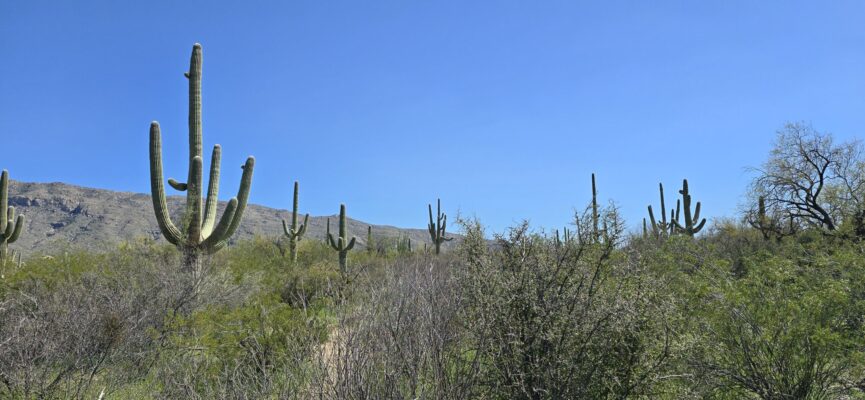
Photograph of a giant saguaro cactusThe saguaro (suh-waa-row), also known as the giant cactus, has been an iconic symbol of the American southwest for ages. These majestic beings are easily recognized by their size and structure, sometimes reaching a height of 50 feet tall. They are native to the Sonoran Desert and do not grow naturally elsewhere.

We visited Saguaro National Park in late March 2024 while staying at the Tombstone Territories RV Resort in Huachuca City, Arizona, about a one-hour drive from the park. The Saguaro National Park has two districts – Rincon Mountain District and Tucson Mountain District – that are separated by the City of Tucson. We visited the Rincon Mountain District on the east side of Tucson, as that was closest to us.

We started our visit at the Rincon Mountain Visitor Center where we were fascinated to learn how long it takes a Saguaro cactus to grow. Branches normally begin to appear when a saguaro reaches 60 to 75 years of age. When a saguaro reaches 35 years of age, it begins to produce flowers. An adult saguaro is generally considered to be about 125 years of age. It may weigh 2 or more tons and be as tall as 50 feet. The average life span of a saguaro is probably 150 – 175 years of age. However, biologists believe that some plants may live over 200 years.

From the visitor center we drove the Cactus Forest Scenic Loop Drive which is a winding paved road that features several trailheads, scenic vistas and pullouts in a total of 8 miles.wide view of numerous ocotillo cactiWe stopped at the Mica View picnic area to enjoy our lunch in the middle of the Sonoran Desert. From the picnic area continued down the scenic drive to the Desert Ecology Trail, a 1/4-mile paved trail with information exhibits along the way about the plants and animals that comprise the Sonoran Desert ecosystem. While the saguaro cactus is the undoubted star of the park, there are a large variety of other plants in the Sonoran Desert. We particularly enjoyed seeing the Teddy Bear Cholla (not nearly as cuddly as its name!), and the elegant ocotillo.

At the southern tip of the scenic loop road, we reached the 1-mile-long Freeman Homestead trail and followed it to the site of an old homestead foundation. There wasn’t much evidence left of the homestead, but the trail was enjoyable and took us through a grove of large saguaros and a desert wash.

Photos of our visit are provided below. Click on the thumbnails to view the photos.

Petrified Forest National Park – Petrified Forest, AZ

Petrified Forest National Park – Petrified Forest, AZ

We made two half-day trips to the Petrified Forest National Park in early November 2023 while staying at the Holbrook/Petrified Forest KOA Journey RV Park, about a half-hour drive from both the south and north park entrances. The Petrified Forest National Park stretches north and south between Interstate 40 and Highway 180. There are two entrances into the park, each one with a visitor center. The petrified log fields are found at the southern end of the park. Outlooks, trails, cultural sites, and painted desert badlands are found in the middle and northern sections.

During both of our visits we drove the full length of the park, southbound on the first trip, and northbound the second time. We stopped at some different overlooks and points of interest each day.

The Painted Desert has a very unique, other-worldly, landscape with colored bands running horizontally through its rolling hills. The colorful Painted Desert badlands are composed of bentonite, a product of altered volcanic ash. The clay minerals in the bentonite can absorb water and swell much as eight times their dry volume. The expansion and contraction properties of the bentonite cause rapid erosion including by preventing much vegetation from growing on—and thus fixing—the slopes of the hills.

There were also views of spectacular mesas and buttes along the park road. Their flat tops are created by the presence of cap rocks, more erosion-resistant rock such as sandstone over softer clays. The softer rock is protected by the cap stones, but, as the sides weather and the protective rock falls down, the softer rock erodes away as it is exposed to the elements. Without the capstone, the feature becomes another rolling badland. Mesas typically are wider than they are tall while buttes are taller than they are wide. Towers, monuments, and hoodoos are even further eroded features.

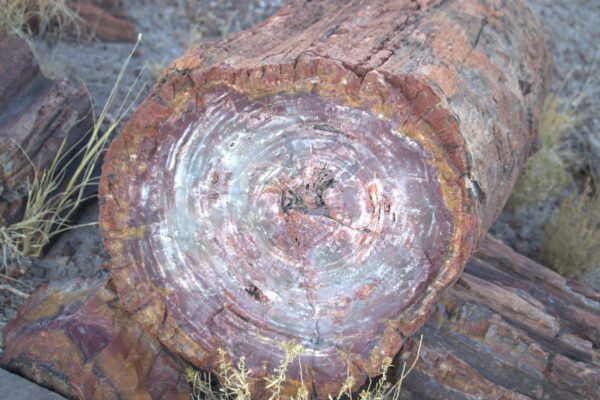
The petrified trees that lie strewn throughout the southern sections of the park are an amazing sight. Initially, looking out over the fields of petrified logs, you might think you are looking at the remnants of recently felled trees, but then you realize that these are actually fossilized trees that are some 200 million years old, and there is a sense that time has stood still in these areas. The quartz within the petrified wood is hard and brittle, fracturing easily when subjected to stress. It is thought that during the gradual uplifting of the Colorado Plateau, starting 60 million years ago, the still buried petrified trees were under so much stress they broke like glass rods. The crystal nature of the quartz created clean fractures, evenly spaced along the tree trunk, giving the appearance today of logs cut with a chainsaw.

Towards the north end of the park, we visited the cultural site of the Puerco Pueblo. A 0.3-mile paved walk winds through the remains of a hundred room pueblo, occupied by the ancestral Puebloan people over 600 years ago. We were able to see Petroglyphs along the south end of the trail, that are still clear and well defined hundreds of years after they were created.

Probably our favorite spot in the park was the Blue Mesa trail, a 1-mile loop descending from the mesa through the hills of the Painted Desert badlands. The loop trail offers the unique experience of hiking among badland hills of bluish bentonite clay as well as petrified wood. We wandered among the hills and petrified logs and were again struck by the timeless quality of the area.

We were able to take the dogs with us on the Giant Logs trail, a 0.4-mile loop behind Rainbow Forest Museum towards the south end of the park. The trail winds around some of the largest and most colorful logs in the park. “Old Faithful”, at the top of the trail, is almost ten feet wide at the base!

Photos of our visit are provided below. Click on the thumbnails to view the photos.

×