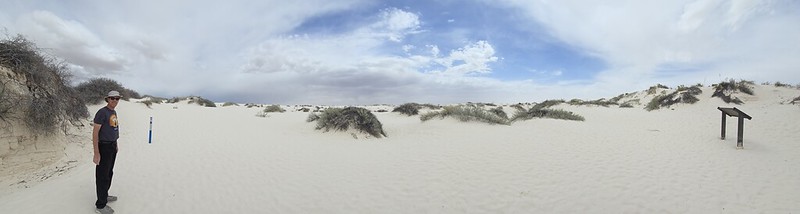
Rising from the heart of the Tularosa Basin is one of the world’s great natural wonders – the glistening white sands of New Mexico. Great wave-like dunes of gypsum sand have engulfed 275 square miles of desert, creating the world’s largest gypsum dune field. White Sands National Park preserves a major portion of this unique dune field, along with the plants and animals that live here.
We visited the White Sands National Park in early April 2024 while staying at the Hacienda RV Resort in Las Cruces, New Mexico about a one-hour drive away.
We stopped at the visitor center at the park entrance and learned about the unique gypsum dunes. Approximately 12,000 years ago, the land within the Tularosa Basin featured large lakes, streams, grasslands, and Ice Age mammals. As the climate warmed, rain and snowmelt dissolved gypsum from the surrounding mountains and carried it into the basin. Further warming and drying caused the lakes to evaporate and form selenite crystals. Strong winds then broke up crystals and transported them eastward. A similar process continues to produce gypsum sand today.
 From the visitor center we took the Dunes Drive, an eight-mile out-and-back scenic drive that leads from the visitor center into the heart of the gypsum dune field. Along the road, there were outdoor exhibits, hiking trails, and picnic areas. Our first stop was the Dune Life Nature Trail. This was an easy one mile loop trail that was a great way to experience the dune field, and its typical landscape of sparse shrubs, cacti, and trees. There were informational signs along the loop.
We also visited the Interdune Boardwalk, an elevated boardwalk that leads you through the fragile interdune area to a scenic view of the dune field and the Sacramento mountains.  There were extensive information displays along the boardwalk with information on the geology, plants, and animal life of the area.
We tried our hand at sand sledding, one of the most unique things to do in White Sands National Park. We met with little success and came to the conclusion that if you weigh more than the average 12-year-old, the physics of sand sledding are not in your favor!
Visiting Great Sand Dunes National Park was a unique experience. Some areas of the park had very little plant life and the bright white gypsum dunes looked just like snow drifts. Interestingly, the dunes always stay fairly cool even on bright sunny days due to the high water table and reflective sand.
Photos of our visit are provided below. Click on the thumbnails to view the photos.


If you would like to stay up-to-date with our travels, sign up for our newsletter, and we'll alert you every so often when we have a new post. We will not share your email with anyone (unless required by law), we do not sell anything, and we will not spam you. You can always unsubscribe from any and all of our lists by visiting our Manage Subscriptions page.
-- Allen & Martin
Discover more from 365RVLiving.com
Subscribe to get the latest posts sent to your email.