We visited Grand Teton National Park in July 2024 while staying at Greys River Cove RV Park in Alpine, Wyoming.
The Grand Teton National Park is named for the spectacular Teton Mountain Range that runs north-south through the park. The principal summits are Grand Teton (13,775 feet), Mount Owen (12,928 feet), Teewinot (12,325 feet), Middle Teton (12,804 feet) and South Teton (12,514 feet).
One reason the Teton Range is famous is because of the dramatic elevation profile visible from the eastern side, which rises sharply from 4,000 to 7,000 feet above the valley floor. Unlike most mountain ranges, the east side of the Teton Range lacks significant foothills or lower peaks which might obscure the view.
We entered the park at its south end, and drove north on Teton Park Road, eventually looping to the east and then south on Hwy-26 back to the south entrance. Near the south entrance we visited the Menor’s Ferry Historic District. Here we got to see what early homestead life in Grand Teton was like. We saw the existing buildings that housed a general store and homestead, as well as a replica of the ferry that used to shuttle traffic across the Snake River. Volunteers in historic costumes were on-site to provide information and answer visitors’ questions. While visiting the Menor’s Ferry area we were lucky enough to see a mother and baby moose crossing the trail a short distance away from us. The volunteers at the site said that it was unusual to see a mother and baby at such close quarters (see the video in this post).
On the north-bound section of our park loop we stopped at several turnouts and viewpoints, as well as the Jenny Lake area. The mountain views were spectacular, and we enjoyed trying to identify some of the 11 active glaciers that exist throughout the Teton range. At Jenny Lake we took a short loop trail along the lake, finding a nice bench to eat a picnic lunch and enjoy the expansive views of the lake and mountains.
On the return section of our park loop, we headed south on Hwy-24, generally following the path of the Snake River. There were several turnouts with great views of the Snake River and surrounding scenery. As we headed further south on Hwy-24 we turned-off onto the short road that dead-ended at Mormon Row, which is highlighted by the two picturesque barns originally built by the Moulton family in the early 20th century. We joined generations of photographers from around the world by taking photos of the famous Moulton barn which capture this iconic historic structure with the Teton Range in the background.
Photos of our visit are provided below. Click on the thumbnails to view the photos.
PLEASE NOTE: This post got the better of me, and I went down a rabbit hole. I still have a minor cleanup, but I wanted to post it as soon as possible. Sorry for the rough draft version, but it’s better than nothing. I hope you find her as interesting as I did. This cabin is one of my favorite places to visit. I find it absolutely beautiful.
Josie Bassett Morris’ Cabin at Cub Creek (40°25′31″N 109°10′29″W) near Jensen, Utah. Source: Allen
Photos By: 365RVLiving.com and courtesy of the J. Willard Marriott Digital Library at the University of Utah (https://collections.lib.utah.edu/)
Josie Morris’ cabin is one of my favorite places I’ve ever visited—so much so that we’ve made the trip out to it from Vernal, Utah, for the second consecutive year. While researching the cabin for this post, I found Josie’s and her family’s story captivating. Their story is truly a fantastic part of the American West. I can easily imagine living there in the late 1800s or early 1900s. I love this small cabin’s mature trees, solitude, and isolation.
Petroglyphs and pictographs on rocks along the road to Josie’s cabin. Source: Allen
It’s several miles down a small county road just off Old Hwy 149 inside Dinosaur National Monument. The last few miles of the road are a well-maintained dirt road, but any car can drive unless it has recently rained. On the way to the cabin, ancient petroglyphs and pictographs were created on nearby walls by the Freemont people living there from around 200 AD to 1300 AD.
There is a small parking lot at the cabin, and two easy hiking trails start there: the Hog Canyon trail and the Box Canyon trail. The Hog Canyon trail is the longer (1.5 miles) and more diverse of the two, while the Box Canyon trail is significantly shorter (0.5 miles) but still beautiful. Please be aware that there is a lot of Poison Ivy along the Hog Canyon trail.
Originally from Arkansas, Herbert and Elizabeth Bassett moved west circa 1877 with their three-year-old daughter, Josie. She and her younger siblings, Samuel Clark Bassett Sr, Ann M (Bassett) Willis, Elbert Bassett, and George Crawford Bassett, grew up in Brown’s Park (originally Brown’s Hole), an isolated mountain valley on the Green River near the Colorado/Wyoming/Utah border known for cattle rustlers, horse thieves, and outlaws.
Due to poor health, Herb, a scholar and musician, could not perform hard labor. Elizabeth, a strong, outdoorsy woman, realized that she needed to provide a living for the family and became a cattle rancher and rustler. She ran the cattle and sheep ranch and raised thoroughbred horses while Herb taught the children.
Josie’s mother, Mary Elizabeth (née Chamberlain) Miller, Attributed to Surreywd2541, CC BY-SA 4.0, via Wikimedia Commons
Elizabeth and Herbert Bassett were comparatively wealthy and educated for homesteaders. By all accounts, they had an unusually open-minded marriage for the time. Elizabeth advocated for women’s right to vote, was interested in feminism, and believed one’s roles should be based on talent and interest rather than gender.
When large cattle companies began to push out small cattle ranchers and homesteaders in Brown’s Park, the Bassetts organized other locals to fight back. They hosted many guests in their home, fostering a strong sense of hospitality, generosity, and community. Some of their guests included Butch Cassidy, Harry Longabaugh (aka. The Sundance Kid), and the “Wild Bunch” gang. They all were close family friends and often stayed and worked at the ranch to “cool down” following their illegal escapades. The Bassetts were known for supplying Butch Cassidy’s gang and other outlaws, such as “Black Jack” Ketchum and Kid Curry, with beef and fresh horses.
Butch Cassidy (seated far right), “Sundance Kid” (seated far left), and three other members of the Wild Bunch in the famous “Fort Worth Five” photograph taken in 1900. Mouse over a person for the name or click them for more information. Source: Wikipedia
Josie and Ann were both considered very attractive and had a wild side. By 1893, Ann was involved romantically with Butch Cassidy, and Josie was involved with Elzy Lay, Cassidy’s closest friend.
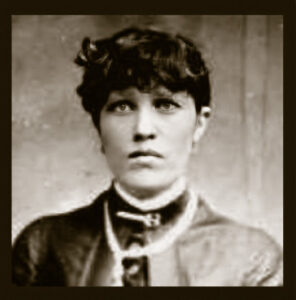
While Cassidy was in prison, Ann became involved with Ben Kilpatrick, another outlaw. By the time Cassidy was released, Will “News” Carver, a “Wild Bunch” member, had become involved with Josie. She ended their relationship when Carver became involved with another “Wild Bunch” member and outlaw, Laura Bullion. Subsequently, Josie becomes involved with Cassidy until he again becomes involved with Ann.
The Bassett girls’ relationships with Cassidy’s Wild Bunch gang developed into a complicated circle. Despite the seemingly constant changes in romantic companions between them and the gang members, there is no indication that animosity ever resulted from this.
In 1896, several powerful and wealthy cattlemen hired cowboys to harass the sisters, stampede, and rustle their cattle to force the sisters to sell their ranch. As a result, the sisters began rustling the cattlemen’s cattle. Fortunately, the cowboys only had limited success as they feared retribution from the Bassett’s outlaw friends.
One legend is that Kid Curry, the most feared of the Wild Bunch, approached several cowboys who worked for the cattlemen and warned them to leave the Bassetts alone. It’s unknown if this story is true, but it is true that by 1899, the sisters were no longer receiving pressure to sell.
Josie married Jim McKnight at the age of 19 in 1893. In 1914, Josie and husband M.B. (Ben) Morris, without much money, established a homestead claim at Cub Creek near Split Mountain (the cabin location within the current Dinosaur National Monument), 40 miles from the family ranch. Her son Crawford and his wife lived there for a time, and grandchildren visited.
Morris was a colorful local character. She married five times and divorced four of her husbands. In her 60s, she was tried and acquitted for cattle rustling and made brandy and wine from local fruit and berries during Prohibition. She lived in the cabin for over fifty years until she fell on ice and broke her hip in 1963. She died the following year at the age of 90.

 At Jenny Lake we took a short loop trail along the lake, finding a nice bench to eat a picnic lunch and enjoy the expansive views of the lake and mountains.