Redwood National and State Parks

Redwood National and State Parks

In 1918 paleontologists wanting to save the Coast Redwoods as a living link to our evolutionary past campaigned nationally to protect the trees. Three California redwoods state parks resulted: Prairie Creek (1923), Del Norte (1925), and Jedediah Smith (1929). To preserve the trees’ natural Coast Range setting and associated plants and animals, Redwood National Park was created in 1968 and expanded in 1978. The national park boundary encircled the three state parks to better protect superlative ancient redwood forests. In 1994 the National Park Service and California Department of Parks and Recreation began managing the parklands cooperatively, aiming to manage the parks the same.

Redwood National and State Parks holds 130,000 acres of forests, rivers, prairies, and rugged coastline, including 40,000 acres of old-growth redwood forests. Today, the Parks’ boundary extends from Crescent City, CA to just south of Orick, CA.

We visited Redwood National and State Parks in October 2024 while staying at the Rambling Redwoods RV Park in Crescent City, California at its northernmost end. We made a couple of visits to the park during our stay. The first visit was to Jedediah Smith State Park near Crescent City. During the second visit we drove most of the length of the park from north to south on the CA-101 with a detour along the Newton B. Drury Scenic Parkway.

Our visit to Jedediah Smith State Park started at the Hiouchi Visitor Center, a short drive from the RV park and just outside Crescent City. At the visitor center we were given printed directions to get to Howland Hill Road, a 10-mile narrow scenic drive which winds through the giant Redwoods and includes numerous pull-outs to allow vehicles to pass, and trailheads along the way, including the Boy Scout Tree Trail , Stout Grove, and Grove of the Titans Trail. Portions of Howland Hill Road were unpaved, but the road was readily passable by any passenger vehicle, although it was so winding and narrow that we rarely exceeded 15 mph along the road. The drive was spectacular, with giant redwoods literally inches from the road on each side, and shafts of light shining dramatically through the tree canopy.

We decided to take the Grove of the Titans Trail about half-way along Howland Hill Road. This trail was completed in summer 2022 to allow sustainable access to a group of ancient redwood trees named for their remarkable shape and size. The grove contains many tall and wide redwoods with complex features and fascinating adaptations. The trail was a 1.5-mile out and back trail with a small loop at the end. There were many awe-inspiring giant trees along this trail and some of the fallen trees were just as spectacular and interesting as the living ones. After our visit to the Grove of Titans, we completed the Howland Hill Road drive back to Crescent City.

For our second trip into the park, we drove the CA-101 most of the length of the park from north to south with a detour along the Newton B. Drury Scenic Parkway. The Scenic Parkway is a 10-mile section of two lane highway that bypasses a section of CA-101 through the heart of the old-growth redwood forest in Prairie Creek Redwoods State Park. North to south, features include numerous trailheads, Big Tree Wayside, Prairie Creek Visitor Center, and Elk Prairie Campground.

As we continued along the Scenic Parkway, we stopped at the Big Tree Wayside area. This is an easy walk to stunning old-growth redwood trees. A viewing platform and interpretive signage was located around the “Big Tree”, said to be one of the oldest in the park with a height estimated to be 286-feet and a diameter of 25-feet. We took a short circle trail next to the big tree that took us through even more spectacular Giant Redwood specimens.

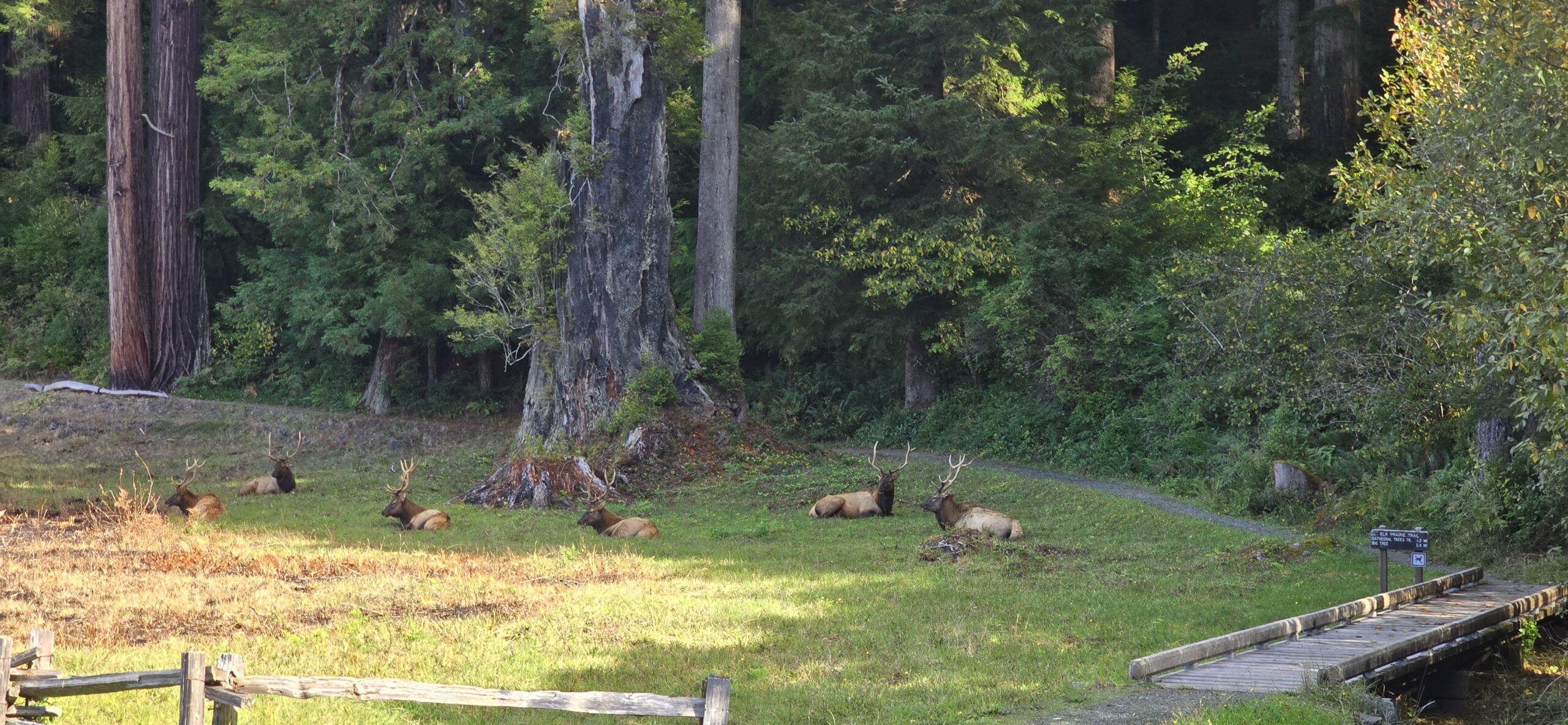
One of the highlights of this visit were the herds of Roosevelt Elk that live around the Elk Prairie area. We were able to watch the Elk as we picnicked at the Elk Meadow picnic area, and then again at the Elk Prairie area a short distance along the scenic parkway. These large Elk were quite majestic as they relaxed in the meadows.

We ended our trip at the Thomas H. Kuchel Visitor Center, located on the Pacific Coast. Exiting the back-door of the visitor center directly onto a sandy beach covered in driftwood, we were met with spectacular views up and down the coast, accompanied by the white breakers reflecting the low afternoon sun.

We really enjoyed our time in the Redwoods. There was a real sense of timelessness amongst trees that have been here for up to 2000 years, and gratitude for the work that has been put-in by the Park Services and others to protect the ancient forests and surrounding areas.

Photos of our visit are provided below. Click on the thumbnails to view the photos.

Coronado Village Mobile Home & RV Resort – Albuquerque, NM

Coronado Village Mobile Home & RV Resort – Albuquerque, NM

Coronado Village Mobile Home & RV Resort is one of our favorite RV parks. Nestled in north Albuquerque, NM, near I-25 and Paseo Del Norte Blvd NE, it’s a surprisingly tranquil spot despite its proximity to the freeway, thanks to its vastness with 350 spaces. We visited twice in May 2023 during spring and again in October 2023 for the Albuquerque Balloon Fiesta.

We travel to Albuquerque often due to Martin’s Vedic chanting workshops and prefer to stay at Coronado Village. No amenities are within walking distance unless you’re up for a mile or two trek.

The standout feature of this park is its 7-acre grassy area at the southern end. Google calls it Scallop Park, though it’s entirely within Coronado Village. The greenbelt boasts large cottonwood, fir, cedar, and mulberry trees.

Springtime in the park is delightful. There is a blanket of yellow dandelions and their seedheads, and the mulberry and cottonwood trees are budding with new growth as the temperature starts heating up. October weather can be cool, but it’s not too cold yet.

During our first visit in May 2023, I expressed interest to the office staff that we would like to attend the balloon fiesta in October 2024. Coincidentally, there was a cancellation on our departure day for the October 2023 Albuquerque Balloon Fiesta. We snagged the reservation immediately, even though the rates spiked during the event. Coronado Village is very close to the fiesta grounds.

October’s visit was spectacular, with balloons landing in the RV park, even right in front of our RV. The weather cooled quickly, requiring a heavy sweater by the end of the month. Early October was mild enough for just a light jacket, even for nighttime fiesta events, to which we rode our e-bikes.

A useful tip we’ve learned for saving money while traveling is to stay for a month when possible, as it often costs about the same as a two-week stay. This usually requires paying for electricity, but staying longer allows us to slow down and truly enjoy the area.

Thousand Trails Pacific City, Oregon

Thousand Trails Pacific City, Oregon

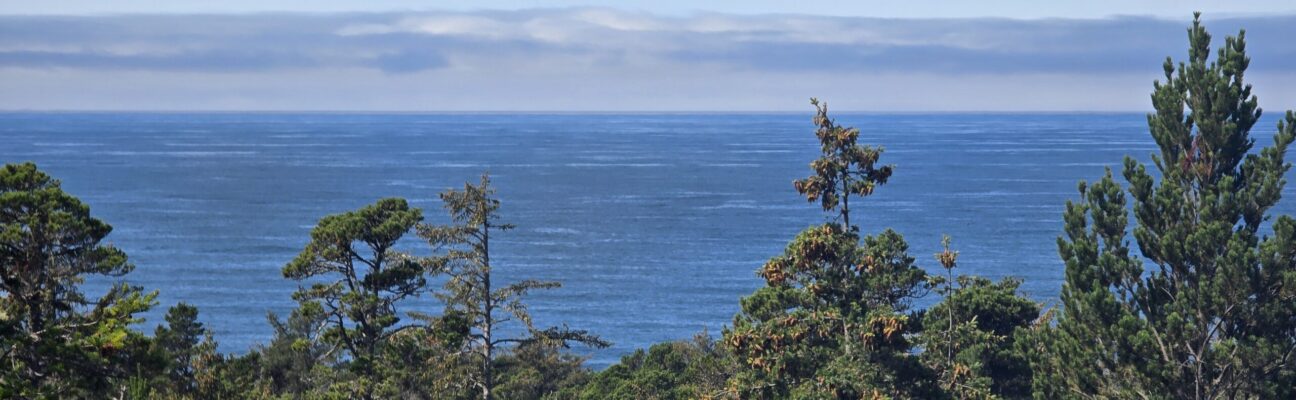
Imagine a 180º view of the Pacific Ocean from a hill 200′ above the water. Well, imagine no more.

We spent eight days at Thousand Trails Pacific City across the street from McPhillips Beach, a vehicle beach in Pacific City, Oregon. That was the view out the back of our RV site.

This is a Thousand Trails (TT) park. If you don’t know TT, we’ll post more about it in the future. Essentially, TTs are campgrounds where anyone can stay for a nightly fee, or if you are a TT member, you can stay for free for up to 21 nights, depending on the type of membership you purchased. Most TTs are near the coast, Great Lakes region, or snowbird locations like Florida, Texas, and Arizona. There aren’t any TT parks in the center of the country.

This park is older but well-maintained, nestled amongst tall, mature evergreens, and has about 300 RV sites. Some sites are full hookups with 50-amp service, but most are 30-amp with only water and no sewer connection. All sites are back in; no pull-through sites. There are 12 or so tree-lined loops with sites spaced throughout. The campground is very hilly, and towing a large RV there is very challenging.  The video to the right begins as we leave check-in and ends when we get backed into our site. It was a slow 30-minute drive from the office to our site, then another 10 minutes to get backed into it.  To shorten the video, I’ve sped it up in places and edited out most of the time we spent pulled over, letting cars pass, or stopped trying to figure out how to negotiate the sharp or narrow turns.  Remember, we’re 60′ long, including the RV and truck, so we can’t take corners too sharply. We’re also 8′ wide, so two RVs can’t pass in opposite directions without someone pulling partially off the road. It was actually close to 45 minutes from the office to our site before editing the video.

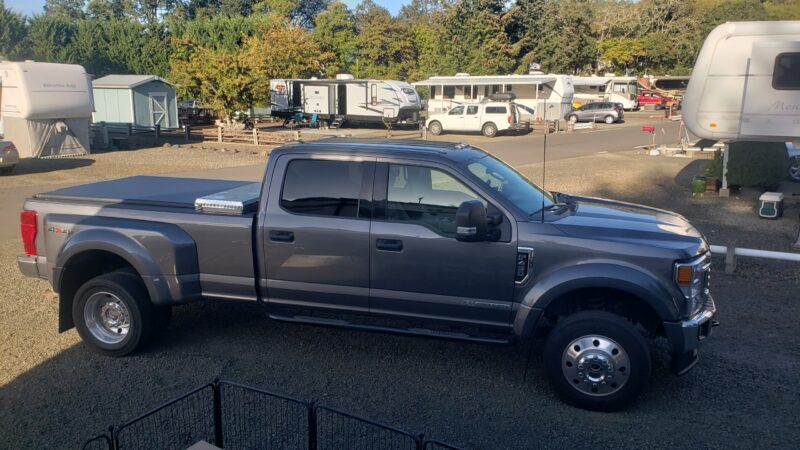
We chose a site with a very steep incline at the front but a great view out the back. The truck wheels spun slightly while pushing the RV up the incline as it was so heavy, and the driveway was sand and gravel. Thankfully, Martin was the spotter and navigator; otherwise, I would not have been able to do it by myself. If you have a large rig and travel alone or aren’t confident and skilled behind the wheel, this might not be the park for you. Also, the Ford F-450’s minuscule turning radius, compared to large Chevys, Rams, F-250s, or F-350s, helped tremendously. No other 22′ vehicle has such a great turning radius!

The video above shows a lot of small rocks strewn on the road. There must have been a big storm before we arrived, as the stones had been swept away a day later. The roads in the park aren’t in great shape. Most are paved, but some are dirt or gravel in places, although we didn’t encounter any significant potholes.

TT does not assign you a specific space at check-in; you pick the site you want by driving around and choosing it upon arrival. You let the office know the site number after you’ve parked. At check-in, we were told there is a section, especially for rigs over 38′, near the park’s far end and up the hill. That section also has the best views in the park. We had to navigate sharp turns and narrow roads to get there. Fortunately, we knew the challenges before we arrived and weren’t surprised. It was also helpful that the office staff told us about this section.

We could have stayed at numerous sites throughout the campground. If we had driven around the loops for a while, we might have found a 50-amp site with sewer available, but we opted to go straight to the over 38′ section. This campground is relatively long, narrow, and parallel to the coast highway.

All loops are nicely landscaped and populated with giant fir and cedar trees, many of which are hundreds of years old. Several walking paths through the woods lead to other sections of the park. Penny and Little Bit loved their walks on the trails and roads within the park. They also enjoyed running on the beach, just a short walk across the highway and down a well-maintained trail.

The weather was perfect during our stay, with highs in the low to mid-60s, fog in the morning that usually dissipated by midday, and only light rain once.

Pacific City is tiny and caters to tourists and conventioneers willing to pay for overpriced restaurants. Not our vibe.  Cloverdale is also small but doesn’t seem to cater to anyone, with virtually no restaurants. Tillamook, about 45 minutes away, is rather shabby but has a few decent restaurants and microbreweries that feature Tillamook Cheese in one way or another. After failing to find several restaurants listed on Yelp, we enjoyed an excellent cheeseburger and local brew at Pelican Brewing.

Unfortunately, we didn’t stop at Tillamook Creamery to take the tour and have lunch as their restaurant’s menu was too limited.

Truck Upgrades – Mudflaps and Tonneau Cover

Truck Upgrades – Mudflaps and Tonneau Cover

While stationary for a month in the Pacific Northwest, we took the opportunity to do some upgrades to our 2022 Ford F-450 truck that we’ve had on the wish-list for a while.

Mudflaps

When we bought the one-year-old truck in 2022 it came with Ford OEM mudflaps on the front only. After about a year, one side had completely torn and broken-off, and the other side was partially torn. The main reason for getting new mudflaps, however, was to avoid the splatter that was thrown-up by the trucks rear wheels and would accumulate on the front of the 5th wheel.

After researching mudflaps quite a bit, and considering both Ford OEM and other options, we settled on the Duraflap brand mudflaps. These mudflaps had great reviews in several forums and were easy to order and customize on the Duraflap website. They weren’t available to purchase in stores, but the online order process and shipping was super-easy and efficient.

When ordering on their website, you select your make, model, and year of truck and then you have several options to select from related to mudflap dimensions and metal weights. The website includes information and guidance on how to measure the truck height to select the best mudflap dimensions. Based on the website guidance we selected the standard length and standard width mudflaps. These give about 7-inch clearance at the rear tires to the road, which drops to about 5-inches when towing the 5th wheel. The short and long options reduce or increase the standard length by 2-inches respectively.

The other main option when ordering is the addition of stainless-steel weights to the bottom of the flaps. There are many options for finish and pattern on their website, however we opted to go with plain mudflaps (no weights) as we liked the clean look of all black flaps with our grey truck. We had read several reviews that said the weights were not needed as the mudflaps themselves were quite thick and rigid.

Installing the mudflaps was a relatively simple process, the most complicated part being the array of metric and imperial sockets and wrenches that were needed to remove and install the various existing and new fasteners. One of the benefits of the Duraflap mudflaps is they are “no-drill”, using existing holes and a combination of new and re-used fasteners.

Based on the limited use to-date, the Duraflap mudflaps get a thumbs-up from us. Initial performance seems good, although we haven’t yet towed the 5th wheel since installing them, so that will be the best test. I’ll update the post once we’ve done some towing.

Tonneau Cover

We wanted to install a tonneau cover to provide additional security and weather protection for items in the truck bed when we are not towing the fifth wheel, and to provide a cleaner appearance for the truck. Some tonneau manufacturers claim up to a 10-percent improvement in fuel economy, so we’ll have to see if that proves to be true.

Our choice of tonneau covers turned out to be limited as we needed a cover that could be folded and left on the truck when towing the 5th wheel, and also work with our truck-mounted toolbox. After researching several manufacturer’s offerings on-line, as well as YouTube reviews on some of our favorite RVing channels, we decided the ACCESS® TOOLBOX EDITION Roll-Up Cover by Agri-Cover, Inc. would best meet our needs. This is an affordable American made product that has excellent reviews. The on-line ordering process was straight forward on their website and shipping was quick and efficient.

Installing the tonneau cover proved to be straight-forward. All the necessary parts and mounting hardware was included, even some alcohol wipes to clean the surfaces where the adhesive gaskets were installed.

Although the tonneau cover install was easy, we also needed to make some adjustments and modifications to the latching mechanism on our low-profile toolbox to make it work with the tonneau. Because it’s a low-profile design, the existing latches on the toolbox were so low that they were blocked by the tonneau cover header bar. We were able to solve this by installing new exterior latches that we purchased on Amazon on the sides of the toolbox and disabling the original toolbox latches by removing the latch striker.

We are very happy with the initial install of the tonneau cover. I’ll update this post once we have some experience using it stowed while towing, and also to find out if we do get better fuel mileage when its deployed.

White Sands National Park

White Sands National Park

Rising from the heart of the Tularosa Basin is one of the world’s great natural wonders – the glistening white sands of New Mexico. Great wave-like dunes of gypsum sand have engulfed 275 square miles of desert, creating the world’s largest gypsum dune field. White Sands National Park preserves a major portion of this unique dune field, along with the plants and animals that live here.

We visited the White Sands National Park in early April 2024 while staying at the Hacienda RV Resort in Las Cruces, New Mexico about a one-hour drive away.

We stopped at the visitor center at the park entrance and learned about the unique gypsum dunes. Approximately 12,000 years ago, the land within the Tularosa Basin featured large lakes, streams, grasslands, and Ice Age mammals. As the climate warmed, rain and snowmelt dissolved gypsum from the surrounding mountains and carried it into the basin. Further warming and drying caused the lakes to evaporate and form selenite crystals. Strong winds then broke up crystals and transported them eastward. A similar process continues to produce gypsum sand today.

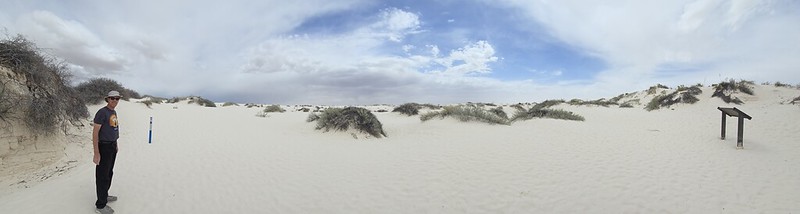
From the visitor center we took the Dunes Drive, an eight-mile out-and-back scenic drive that leads from the visitor center into the heart of the gypsum dune field. Along the road, there were outdoor exhibits, hiking trails, and picnic areas. Our first stop was the Dune Life Nature Trail. This was an easy one mile loop trail that was a great way to experience the dune field, and its typical landscape of sparse shrubs, cacti, and trees. There were informational signs along the loop.

We also visited the Interdune Boardwalk, an elevated boardwalk that leads you through the fragile interdune area to a scenic view of the dune field and the Sacramento mountains. There were extensive information displays along the boardwalk with information on the geology, plants, and animal life of the area.

We tried our hand at sand sledding, one of the most unique things to do in White Sands National Park. We met with little success and came to the conclusion that if you weigh more than the average 12-year-old, the physics of sand sledding are not in your favor!

Visiting Great Sand Dunes National Park was a unique experience. Some areas of the park had very little plant life and the bright white gypsum dunes looked just like snow drifts. Interestingly, the dunes always stay fairly cool even on bright sunny days due to the high water table and reflective sand.

Photos of our visit are provided below. Click on the thumbnails to view the photos.


×